

Käthe Kollwitz
Königsberg
1867 -
Moritzburg
1945
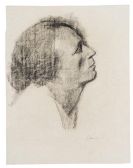
The German graphic artist, drawer, painter and sculptor Käthe Kollwitz was born on July 8, 1867 in Königsberg by the name of Käthe Schmidt. She married the physician Karl Kollwitz from Berlin in 1891.
Käthe Kollwitz receives first art training from the painter Gustav Naujoks and the engraver Rudolf Mauer in Königsberg as early as in 1881. She attends the drawing classes of Karl Stauffer-Bern at the "Verein der Künstlerinnen" (Association of Female Artists) in Berlin as of 1886. She returns to Königsberg in 1887 and takes further classes with the painter Emil Neide, finally studying in Munich under Ludwig Herterich from 1888-1890. Having gone back to Königsberg she marries Karl Kollwitz in 1891, who takes over a doctor's practice in Berlin at the Prenzlauer Berg, to where the couple moves the same year.
Käthe Kollwitz shows a continued interest in illustrations and printing techniques, she also executes her first etchings. Encountering works by Max Klinger leave a deep impression with her. She reads the writing "Malerei und Zeichnung" (Painting and Drawing) in 1892 and finds her favor for graphic art confirmed. Her first son Hans is born the same year. She attends the debut performance of Gerhart Hauptmann's play "Die Weber" (The Weaver) in 1893 and picks up working on a graphic cycle on the topic "Ein Weberaufstand" (A Weaver's Revolution). The work impresses the jury of the "Große Berliner Kunstausstellung" (Great Berlin Art Exhibition) in 1896 so much that they award her the small gold medal. Max Lehrs, head of the Dresden print room, begins collecting works by Käthe Kollwitz the very same year. A first catalogue raisonné is published as early as in 1903.
The artists gives birth to her second son Peter in 1896. She teaches at the Berlin Artist's school from 1898 to 1903, starting to work on her cycle "Bauernkrieg" (Peasants War) the same year. During a several week study visit to Paris in 1904, she attends sculpting classes at the Académie Julian and meets Auguste Rodin in his studio. She also executes drawings in market halls and night bars. Käthe Kollwitz is awarded the Villa-Romana-Price in 1907 and spends several weeks in Florence, completing the cycle "Bauernkrieg" (Peasants War)in 1908.
Both her sons volunteer in World War I, her younger son dies in 1914 at the age of 18. The mourning of her son's death and the call for peace preoccupy the artist for several years. She also depicts her impressions war, hardships, starvation and miseries of the working class in her works in a very haunting manner.
Käthe Kollwitz becomes the first female member of the Prussian Academy of Arts in 1919 and is appointed professor, she is also given her own studio at the academy. She is forced to withdraw from the academy in 1933, because of her pacifist and political activities. The series of lithographs "Tod" (Death), comprising eight sheets, from 1934/35 express her deep resignation and her longing to die. She expresses her sorrow over her husband's death (1940) in the sculpture "Der Abschied" (Farewell) from 1940/41. She makes the lithograph "Saatfrüchte sollen nicht vermahlen werden" in 1942. Her studio is bombed a the next year. She is allowed to move to the Rüdenhof near Schloss Moritzburg by order of the Saxon prince Ernst Heinrich,in 1944 where she dies on April 22, 1945.

Would you like to sell a work by Käthe Kollwitz?
Infos for seller


Starting bid: 9,000 EUR